
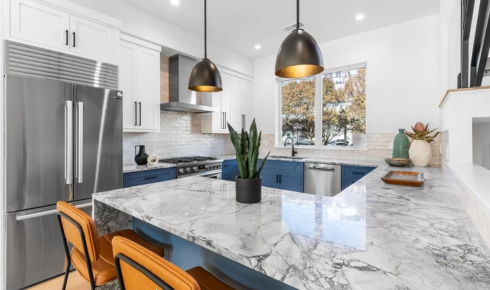
Marble countertops are known for their elegance and timeless appeal—but behind every finished surface is a detailed fabrication process that transforms raw stone into a custom-fitted centerpiece. For homeowners in the Metro Philadelphia area, understanding how marble countertops are made offers valuable insight into the craftsmanship and technology involved.
Local experts like Cosmos Marble & Granite, a family-owned business with over 30 years of experience, handle every stage of this process in-house—from slab selection to final installation. Here’s a behind-the-scenes look at how marble countertops come to life inside a professional fabrication shop.
1. Selecting and Inspecting the Marble Slab
The process begins with choosing the right slab. Unlike manufactured materials, marble is completely natural—meaning no two slabs are identical.
Fabricators inspect each slab for:
- Color consistency
- Veining patterns and movement
- Structural integrity (no cracks or weak spots)
Homeowners are typically invited to view and approve the exact slab, ensuring the final product matches their expectations.
2. Digital Templating of the Space
Before cutting begins, installers create a digital template of the homeowner’s kitchen or bathroom. This step captures:
- Exact dimensions
- Wall irregularities
- Sink and appliance cutouts
- Overhangs and edge details
In Philadelphia homes—especially older rowhomes—this precision is critical for achieving a seamless fit.
3. Slab Layout and Vein Matching
Next, fabricators map the template onto the marble slab. This step is both technical and artistic.
They determine:
- Where each cut will be made
- How the veining will flow across the countertop
- Where seams will be placed
For high-end projects, fabricators may use bookmatching, aligning veining patterns symmetrically for a dramatic effect on islands or backsplashes.
4. CNC or Waterjet Cutting
Once the layout is approved, the slab is cut using advanced machinery such as:
- CNC (Computer Numerical Control) machines
- Waterjet cutters for intricate shapes
These machines follow the digital template precisely, ensuring:
- Clean edges
- Accurate dimensions
- Perfectly sized cutouts for sinks and cooktops
This technology minimizes human error and improves overall quality.
5. Edge Profiling and Shaping
After cutting, the edges of the marble are shaped according to the selected style.
Common edge profiles include:
- Eased (straight) edges
- Beveled edges
- Ogee or decorative edges
- Mitered edges for thicker appearances
Specialized tools smooth and refine the edges, ensuring consistency across all pieces.
6. Polishing or Honing the Surface
The marble is then finished to achieve the desired look.
Options include:
- Polished finish – glossy and reflective
- Honed finish – matte and soft
- Custom finishes depending on design preferences
This step involves multiple stages of grinding and polishing to create a smooth, even surface.
7. Creating Sink and Fixture Cutouts
Fabricators carefully cut openings for:
- Undermount sinks
- Faucets
- Cooktops or accessories
Precision is critical here—improper cutouts can lead to installation issues or structural weakness.
8. Quality Control and Inspection
Before leaving the shop, every piece undergoes a detailed inspection.
Fabricators check for:
- Smooth edges and finishes
- Accurate dimensions
- Clean cutouts
- Consistent veining alignment
Any imperfections are corrected to ensure the highest quality standard.
9. Sealing the Marble
Marble is porous, so it must be sealed to protect against moisture and stains.
Sealing:
- Reduces absorption
- Helps prevent staining
- Prepares the surface for everyday use
Installers typically apply an initial sealer before or during installation.
10. Preparing for Installation
Finally, the finished pieces are labeled and prepared for transport.
Installers plan:
- Safe handling of heavy slabs
- Proper sequencing for installation
- Protection of the stone during transit
This preparation ensures installation day is efficient and damage-free.
Why In-House Fabrication Matters
Not all companies handle fabrication locally. Working with a shop like Cosmos Marble & Granite offers:
- Better quality control
- Faster turnaround times
- Consistent craftsmanship
- Clear communication from start to finish
This is especially important for Philadelphia homeowners dealing with unique layouts or older homes.
Final Thoughts
Understanding how marble countertops are made reveals the level of precision, technology, and craftsmanship required to create a flawless finished product. From slab selection and digital templating to CNC cutting and polishing, every step plays a role in delivering countertops that are both beautiful and durable.
By working with experienced local professionals like Cosmos Marble & Granite, homeowners gain confidence that their marble countertops are crafted with care and expertise. The result is a custom surface that enhances your home’s design while standing the test of time.
This post was written by a professional at Cosmos Marble & Granite. https://cosmosmg.com/
is a family-owned countertop company with 30+ years of experience serving Huntingdon Valley, PA. We specialize in natural and engineered stone for kitchens, bathrooms, and commercial projects. As a leading choice for countertop installation near you, our team delivers precise cuts, minimal seams, and exceptional finishes. Homeowners looking for kitchen countertop installers near you or a reliable marble contractor near you choose Cosmos for quality, speed, and craftsmanship. We proudly serve metro Philadelphia, New Jersey, New York, and Maryland with premium stone solutions built to last.